Last updated November 17, 2026


Free written scope consultation - allowances, timeline, and change-order rules on paper before a single trade is scheduled
Driveway & Pavers Troubleshooting: Common Problems and How to Fix Them
Three pavers rock when you step on them, so you pull them up, add a little sand, and set them back. Two good rains later, they’re rocking again. Here’s the part most homeowners never hear: the paver wasn’t the problem. The base beneath it had already washed out, and no amount of re-setting fixes a foundation that’s gone. Dallas averages about 37 inches of rain a year, much of it in fast, high-intensity summer storms, and that water has to go somewhere. When it goes under the pavers instead of off them, you get settlement, shifting, and joint sand that disappears. This guide walks through the four root causes behind almost every paver failure, how to tell them apart, and what each repair actually costs.
Quick Answer
Almost all driveway paver problems come down to one of four root causes: a failed base, a failed edge restraint, improper joint sand, or a drainage miscalculation. The visible symptom – a rocking paver, a sunken section, sand washing out – is rarely the actual problem. Diagnosing the cause before repairing the symptom is what keeps a fix from failing again within two seasons.
Styles & brands we work with
- Kitchen remodeling
- Bathroom remodeling
- Home additions & ADU
- Roofing
- Windows & doors
- Driveway & pavers
- Fence
Table of Contents
- The Symptom Isn’t the Cause
- A Diagnostic Decision Tree
- Base Failure vs. a Loose Paver: The Hundreds-vs-Thousands Test
- Polymeric Sand Washout in Dallas Storms
- Edge Restraint: The Repair Most Homeowners Skip
- Tree Root Intrusion and What It Really Costs
- Drainage Miscalculation: The Slow-Motion Failure
- What to Gather Before You Call a Contractor
The Symptom Isn’t the Cause
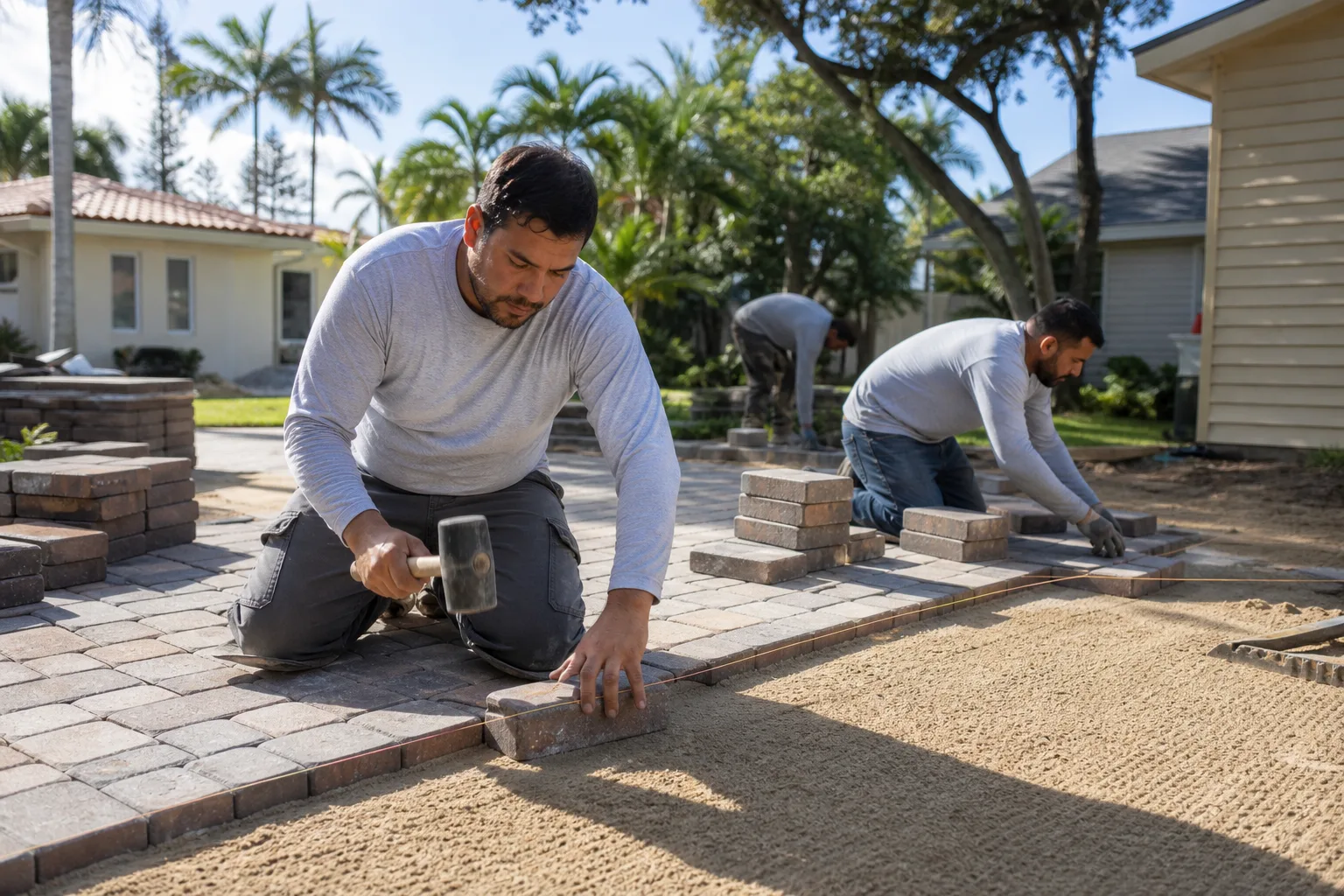
Paver driveways are systems. The surface course (the pavers you see), the bedding layer (usually a thin sand or fine-gravel course), the base (compacted aggregate, typically 4 to 8 inches depending on traffic), the edge restraint, the joint sand, and the drainage plan all have to work together. When one fails, the symptom often shows up somewhere else entirely.
A sunken section near the apron might be a base failure, a drainage problem, or a tree root pushing the whole assembly up in a different spot. A rocking paver on an isolated corner is usually a simple dislodge. Same look, very different repair.
Treating the symptom – re-setting the paver, adding more sand, tapping down the rocker – addresses the surface and leaves the cause in place. Two seasons later, the same failure reappears, often wider. The homeowners we work with in Dallas who get the longest life out of their paver driveways are the ones willing to spend a little diagnostic time up front on what’s actually happening under the surface.
That’s also why we put the number in writing before anybody picks up a tool. Under Clause 1 of the Haven Standard, the price is written before work starts, on the diagnosis – not on a guess about what the visible symptom means. If a contractor can’t describe the failing system in plain terms, the repair scope is a guess.
A Diagnostic Decision Tree
Match what you’re seeing to the likely root cause. Each symptom points to a different repair scope and a different price band.
- Visible crack running through a paver, or a hairline at the joint line: Isolated cracked paver is likely impact or a defective unit. A crack that traces a long line across many pavers is more often base movement or tree roots. Replace the paver only if it’s isolated; investigate underneath if the crack is long.
- A single rocking paver with clean edges: Almost always a simple dislodge. The paver has lifted out of the bedding sand, usually from settlement of the bedding layer alone. The base is intact. Lift, clean, re-bed, and re-set.
- Sunken area, several pavers, progressive: Base failure. If the dip deepens over months, and the surrounding pavers feel loose or hollow when you tap them, the aggregate beneath has lost compaction or washed out. This is a partial rebuild of the affected area, not a spot repair.
- Joint sand missing, pavers look “fuzzy” between them: Joint sand erosion. If the sand alone is gone but pavers are stable, re-sanding may be sufficient. If edge pavers are also moving, the edge restraint has failed – see the edge restraint section below.
- Pavers heaved up at the perimeter, or the drive edges look “tented”: Edge restraint failure, root intrusion, or freeze-thaw movement. The perimeter work is where this concentrates.
- Water pooling in the same spot after every storm: Drainage miscalculation. Repairs here may involve re-grading, adding a channel drain, or re-sloping a section of the driveway. Re-setting pavers without fixing drainage will only put them back in the same puddle.
Two or three of these often appear together. A drive with edge restraint failure will typically also show sand washout, because the restraint was the thing holding the joint sand in.
Base Failure vs. a Loose Paver: The Hundreds-vs-Thousands Test
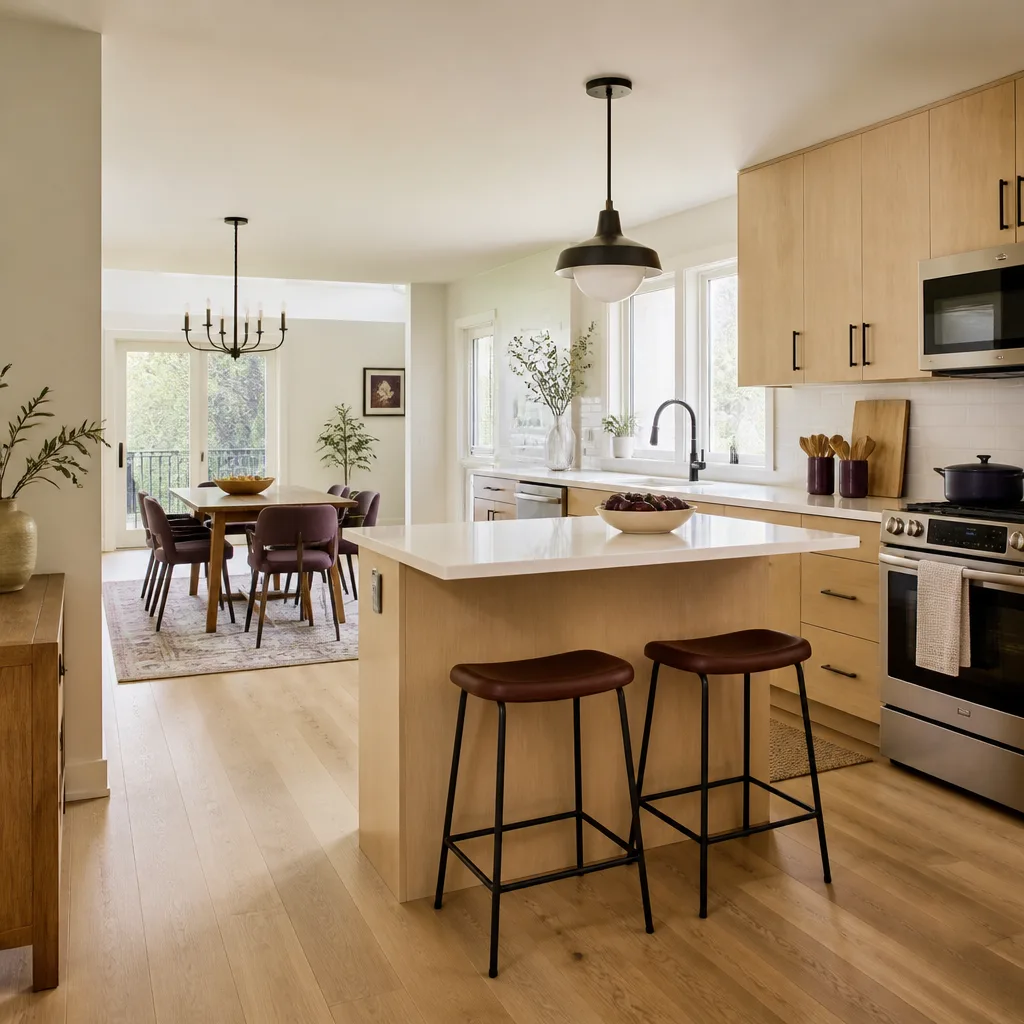
This is the distinction that changes the repair cost by an order of magnitude, so it’s worth getting right.
A dislodged paver has clean edges, doesn’t rock beyond a small radius, and its neighbors are firm. The bedding sand has settled out from under it. The base is fine. Repair typically runs a few hundred dollars for a proper lift-and-reset, sometimes less if the contractor is already there for other work.
A base failure shows these signs:
- The dip is progressive – it gets deeper over months, not days
- More than two or three pavers move together, and the movement spreads
- Tapping the pavers produces a hollow sound over a wide area, not just one paver
- The settled area is lowest in the middle of the drive, where traffic loads concentrate
- The pavers around the settled area have begun to separate at the joints
When the base has failed, the repair is a partial or full rebuild of the affected area: lift the pavers, remove and re-compact the base, and re-lay with a new bedding layer. In the Dallas market, a properly rebuilt section typically runs into the low thousands, depending on square footage and access. The number goes up fast if the failed area is large or if the base material needs to be replaced rather than just re-compacted.
The tell that separates the two, in our experience, is rate of change. An isolated dislodge appears suddenly. A base failure develops. If you can’t remember exactly when the dip appeared but you’re sure it’s bigger than it was a few months ago, treat it as a base issue and get it looked at.
Polymeric Sand Washout in Dallas Storms
Polymeric sand is the joint fill that locks pavers together and stops water from channeling down into the base. When it cures properly, it’s semi-rigid. When it doesn’t, or when the joint becomes too wide for the sand to bridge, it washes out in the first hard rain.
Dallas makes this worse than most markets. A single summer storm can drop an inch and a half in an hour, and that intensity puts the joint sand through a stress test that a slow, soaking rain never does. Add our high summer heat, which cures polymeric sand faster than the clock says it should, and the setup window narrows. Application timing is a real skill here.
Identifying whether re-sanding alone is enough:
- Look at the joint width. If joints are wider than spec (each paver brand publishes an allowable range, typically 1/8 to 1/4 inch), the sand can’t bridge reliably. Fix the joint width first, or re-sanding will blow out again.
- Check the perimeter. Sand collects at the low point and blows out where the water exits. If the perimeter pavers move independently, edge restraint has failed – see below.
- Test with a garden hose at normal pressure on a small section. If you can displace the new sand with normal flow, the sand isn’t going to survive a storm.
- Look at the base under a missing-sand joint. If you can push a screwdriver a few inches into the joint without resistance, the base has already begun to wash. That’s beyond sand repair.
Re-sanding alone is the right call when the joints are stable, the edge is intact, and the loss is localized. When all three aren’t true, sanding is a temporary cosmetic.
Edge Restraint: The Repair Most Homeowners Skip

Edge restraint is the aluminum, steel, or concrete curb that runs along the perimeter of the driveway and holds the pavers in place under load. It’s buried and invisible when it’s working. When it’s not, the pavers at the edge spread outward, joints open, sand blows out, and the whole assembly begins to slide.
Almost every “my pavers keep washing out” call we get in Dallas is at least partly an edge restraint story. The homeowner sees the sand loss and orders more sand, and the new sand disappears because the restraint is still failed. The pavers are effectively loose tiles on a floor with no walls.
Signs the restraint is failing:
- Edge pavers move independently when you step on them, and neighbors don’t
- A visible gap has opened between the driveway edge and the adjacent lawn, curb, or landscape bed
- The aluminum edge strip has rusted, bent, or pulled out of the ground in visible sections
- After a heavy rain, sand collects in a line outside the driveway
Repair typically involves resetting or replacing the edge strip, re-compacting and re-spiking it into the base, and re-filling the joints. It’s a moderate repair, usually in the hundreds per linear section, but it’s the difference between a paver drive that holds its sand through the next storm and one that doesn’t.
Tree Root Intrusion and What It Really Costs
Older Dallas neighborhoods – think the blocks around White Rock Lake, parts of East Dallas, and the streets that date to the 1940s and ’50s – have mature live oak coverage. Live oaks are beautiful and they’re relentless. Roots run shallow and wide, and a paver driveway sitting 6 inches above them is no obstacle.
Root intrusion shows up as pavers heaved upward in a curving line, sometimes 1 to 3 inches above the surrounding plane. The drive looks “tented.” You may also see cracks in the pavers over the root, or a section that has lifted while its neighbors stayed put.
Realistic repair cost range in Dallas: $400 to $1,200, depending on scope.
- Lower end ($400 to $600): A single root can be cut at the property line, one section of pavers lifted and reset over the cut. No removal of the tree.
- Mid range ($700 to $900): Multiple roots or a larger lifted area, requires more pavers to be lifted, base re-compacted, and the edge restraint adjusted to accommodate.
- Upper end ($1,000 to $1,200): An area with significant root mass, where re-laying involves re-grading the base and possibly installing a root barrier to prevent the same failure within a few seasons.
A patch – just tamping the pavers down over the root – feels like a repair and isn’t. The root keeps growing, the paver comes back up, and you’re paying again next year. The honest comparison isn’t $400 vs. $1,200, it’s doing it once properly vs. patching it repeatedly.
On tree removal: we don’t remove healthy trees. If the tree is in good health, a root barrier and re-grade is the standard approach. Dallas arborist rules and tree ordinances may apply if root cutting is extensive – a licensed professional should advise.
For larger outdoor projects that involve tree work, drainage, or structural integration, our Home Additions & ADU in Dallas team handles sitework that grades around mature trees.
See the difference
 Before
 After
 Before
 After
 Before
 After
Drainage Miscalculation: The Slow-Motion Failure
Some paver driveways fail very slowly, and the cause is that the water was never routed off the surface properly. Pooling in the same spot after every storm, a permanent damp patch, or a drive that slopes back toward the garage instead of away from it – all drainage tells. The original installer either didn’t check the fall, didn’t include a channel drain where one was needed, or assumed the lawn was going to drain a section it couldn’t.
Repair paths, in order of escalation:
- Verify surface fall. A paver drive should slope away from the house and toward a drain or daylight point at roughly 1/8 to 1/4 inch per foot. A laser level check settles this in fifteen minutes.
- Add a channel drain or trench drain at the pooling location, tied into the storm system or a dry well. This is often the least-disruptive fix – no need to lift the whole driveway.
- Re-grade a section if the fall is wrong. This is real work, and the pavers over the affected area get lifted and re-laid.
- Check roof runoff and gutter discharge. Many driveways fail because the downspouts dump directly at the drive edge. A downspout extension or buried line is cheap and often solves the issue without touching the pavers.
Drainage problems aren’t just cosmetic. Water under the base strips compaction, and that’s how a base failure starts. Fix drainage before re-setting pavers over the wet spot.
If your driveway and pavers are already beyond repair cycles and replacement is on the table, our team handles Driveway & Pavers in Dallas with a written scope before work starts. And if the perimeter work is part of a broader exterior plan – a new drive, walkway, and fence line installed together – our Fence Installation in Dallas team often coordinates with the paver crew so the drainage plan covers both.
What to Gather Before You Call a Contractor
The best five-minute investment you can make: document the problem before you call. A contractor who can see what you’re seeing will price more accurately and more honestly, and you’ll be able to compare quotes apples-to-apples.
What to collect:
- Photos with something for scale. Place a tape measure, a coin, or a shoe next to the problem area so the crack width or settling depth reads. Shoot in daylight, standing back about 10 feet, and close up.
- Approximate date the problem appeared and whether it’s growing. “It showed up after the storm on May 3rd and has widened by about an inch” is far more useful than “it’s been like that a while.”
- Original installation records if you have them. The installation date, installer name, paver brand, and base depth (if documented). Many homeowners won’t have these – the prior owner installed the drive – but ask for them from your home file or from the seller’s disclosure package.
- A note of where water goes in a heavy rain. Which direction it runs, where it pools, and where it exits. If you can, take a photo during or right after a storm.
- Any tree locations and species on or adjacent to the property, especially if they’re mature canopies.
Bring all of this to the estimate, and any contractor who doesn’t ask for it deserves a second look. We offer a free second opinion on any written estimate – bring a competitor’s quote and we’ll review it line by line at no charge. That’s useful whether or not we end up doing the work.
Common Mistakes to Avoid
- Re-setting pavers without checking the base. If the base is failing under an isolated rocker, the fix holds for weeks, not years. Diagnose before you repair.
- Ordering more polymeric sand when the joint width has failed. Sand can’t bridge a joint that’s too wide, no matter how carefully it’s applied. Fix the joint, then re-sand.
- Skipping edge restraint because it’s out of sight. In Dallas, edge restraint is the single most common cause of the sand washout most homeowners blame on the sand.
- Patching pavers over a tree root. The root keeps growing. Patching is a repeat repair, and the cumulative cost over three seasons typically exceeds the cost of doing it right the first time.
- Ignoring drainage because “it dries out eventually.” Every wet season under the base is compaction lost. Drainage problems escalate quietly.
- Hiring on an hourly rate. Paver repair is scope-based, not hours-based. A written fixed price prevents the cost from moving once the pavers are up.
- Not asking for a written warranty. A repair without a written warranty is a promise, and promises fade.
When to Call a Professional
Call a professional if any of the following is true:
- The settled or heaved area covers more than two or three pavers, or has grown over time
- You’ve re-set the same pavers more than once and the problem keeps coming back
- Edge restraint looks bent, pulled out, or displaced along more than a couple of linear feet
- Tree roots are visibly heaving a section of the driveway, or the roots are near the foundation
- Water pools in the same spot after every storm, or the drive has begun to slope back toward the garage
- You’re seeing hollow, tapping-loose pavers anywhere in the field of the drive
Rowan Construction Group Dallas offers free estimates in Dallas – call (833) 954-5327. Every job starts with a written scope and a written price, and no work proceeds on a change until the change order is signed. Every visit includes a documented photo record – our crew photographs what was found and what was done, so you have evidence in hand, not a verbal summary. Our technicians have up to 19 years of experience, and our work is backed by the 365-Day Done Right Promise: if it isn’t done right, we make it right.
Frequently Asked Questions
Isolated dislodged pavers typically run a few hundred dollars to lift, clean, re-bed, and re-set. Base failures run into the low thousands because the base has to be re-compacted before the pavers go back down. Tree root repairs typically fall in the $400 to $1,200 range depending on scope. Call (833) 954-5327 for an exact quote – estimates are free, and the price is written before any work starts.
Almost always a failed edge restraint or a joint width that’s too wide for the polymeric sand to bridge. Dallas storm intensity accelerates both. Re-sanding alone won’t fix it – the restraint or joint spec has to be corrected first, or the new sand will disappear on the next storm. Call (833) 954-5327 and we’ll walk through the cause before recommending the repair.
For an isolated, clean-edged paver on firm ground, yes – a lift-and-re-bed is within reach for a confident DIYer. If the paver rocks and its neighbors feel loose, or you’ve re-set it before and it’s rocking again, the base is failing and a spot repair will not hold. That’s when to call. (833) 954-5327.
No. Our price is written before anyone starts, and no work proceeds on a change until the change order is signed. If the scope expands because the base looks worse than expected once we lift the pavers, we stop, write the change, get the signature, and then proceed. Call (833) 954-5327 for a free estimate.
A repair that addresses the root cause – base re-compaction, edge restraint reset, drainage corrected – should hold through many Dallas storm seasons. A symptom repair (patch or re-sand without fixing the cause) typically fails within one to two seasons. The 365-Day Done Right Promise covers our work for a full year: if it isn’t right, we make it right.
Simple reset work usually doesn’t require a permit. A full driveway replacement, one that changes the footprint or grade, or work that ties into storm drainage usually does, and we handle that as part of the scope. The permit question is on the quote so you know exactly what’s covered. Call (833) 954-5327 for a free estimate on your Dallas property.
The Bottom Line
Almost every paver problem traces back to one of four root causes, and the visible symptom is rarely the actual problem. A rocking paver, a sunken section, and a sand washout each point to a different repair with a very different cost. The two questions that matter most are whether the base has failed (hundreds vs. low thousands) and whether the edge restraint is intact (the difference between a sand repair that holds and one that doesn’t). Document the problem, diagnose the cause, get the price in writing, and the repair lasts. Skip the diagnosis, and you’re back on the same pavers in two seasons.
Start with our Rowan Construction Group Dallas home page to see all seven trades we cover, or call us directly to schedule a free estimate. We answer calls 24/7, and every estimate is a written price before any work starts.
Call (833) 954-5327 today to schedule your free Dallas driveway and paver estimate. Bring a competitor’s quote if you have one – we’ll review it line by line at no charge. If it isn’t done right, the 365-Day Done Right Promise means we make it right.
Written by the team at Rowan Construction Group Dallas.